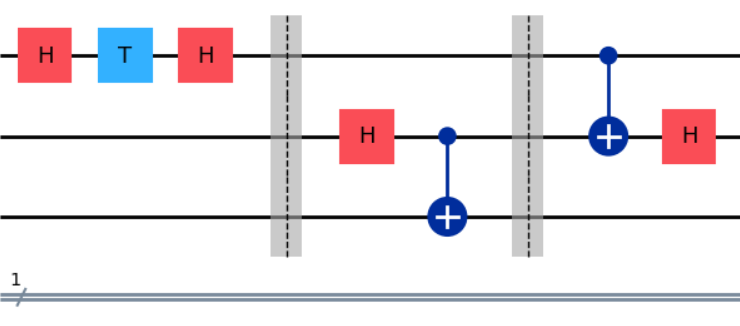
Without checking online or asking your favorite chatbot – do you have any idea what this diagram shows?
A Meeting with the Future
Thirty years ago, I started my computer science degree, where I took Algorithms 1 and Algorithms 2. That was where we learned about complexity, about P and NP, and about the rest of the rules that characterize algorithms running on a computational machine.
Two years later, when I was in my third year, a paper was published that made us feel as if the universe was not quite the one we had known, and that one day our field would look completely different. The paper described one of the first and most fundamental quantum circuits ever built, and the capabilities hidden inside quantum computation.
We did not go too deeply into the physical details back then, and we did not exactly understand how it worked, but it was clear to us that one day, the ideas around non-polynomial algorithms would take on a completely new form.
I waited patiently for 28 years, and what then looked like science fiction is now becoming reality before our eyes.
Quantum Circuits
We are already in the future.
Recently, I have started diving into the worlds of quantum computing, and it feels as if I have jumped aboard the Enterprise for a visit.
Ideas that, until not long ago, seemed fictional can now be run — for the modest price of $1.60 per second — yes, per second 🙂 — on a real quantum machine.
Anyone can now build circuits that solve, in polynomial time, problems involving a superposition of countless states, which a Turing machine, even running on the latest processor, would have to compute serially and with exponential complexity.

Vacuum Tubes and Punched Cards
Today’s classical software world, even before vibe coding burst onto the scene, lets us write a few lines of code that turn into a system performing millions of computations, thanks to libraries, interpreters, and compilers that transform abstract instructions into a long sequence of basic machine commands.
The average programmer is not concerned with how the silicon running their software is built, or how one can use only a NAND gate to construct all the logical gates we need, then use those gates to build an ALU, and then use that ALU to perform complex calculations on 64-bit numbers and loops with sophisticated exit conditions.
The world of quantum computing is not there yet.
The most advanced quantum computers currently contain fewer than a few hundred qubits. In practice, the limitations caused by physical errors make any computation involving more than a handful of qubits, or lasting more than a few operations, become irrelevant.
In that sense, the current state of quantum computing resembles the stage at which digital computation was performed using vacuum tubes, or the early days of punched cards.
The magical gates of quantum computing, which replace the logical gates familiar to us, are currently the building blocks of the field.
Building the Future
In the coming years, the field is expected to undergo revolutions similar to those digital computing went through.
They will not be identical, and they will be much faster.
It is still hard to predict which possibilities this will open for us, but it is clear that many more surprises are waiting ahead.
There is something to look forward to!